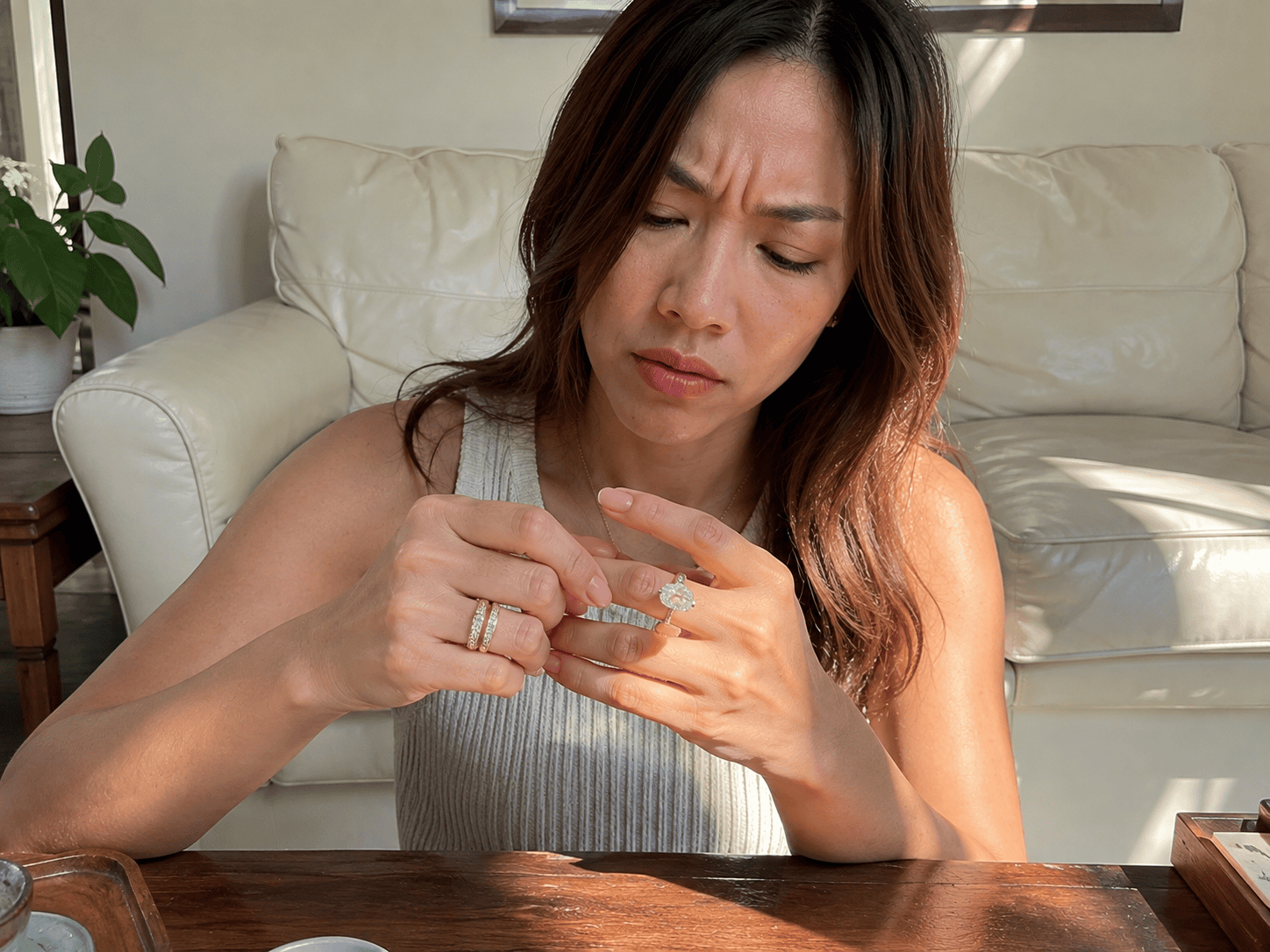
You look down at your hand, expecting to see your beautiful center stone, but instead, you see a plain metal band. Your engagement ring has flipped upside down again.
If you find yourself constantly twisting your ring back into place, you are not alone. A spinning engagement ring is one of the most common frustrations in fine jewelry. But why does it happen? The answer comes down to a mix of basic physics and the unique anatomy of your hands.
Here is exactly why your ring won't stay put, and the professional adjustments you can make to finally keep your diamond front and center.
The Physics of a Top-Heavy Ring
The most common reason a ring spins is simply gravity. Modern engagement rings often feature a large center diamond or gemstone set on a very thin, delicate metal band.
When you have a significant amount of weight concentrated at the very top of the ring and very little metal weight at the bottom to counterbalance it, the ring becomes incredibly top-heavy. Gravity naturally wants to pull the heaviest part toward the ground. So, the moment you move your hand, walk, or type, the weight of the stone drags the setting down to the palm side of your finger.
The Anatomy of Your Hand: Knuckles vs. Fingers
Even a perfectly balanced ring will spin if it isn't interacting well with the shape of your finger. Your hand's anatomy plays a massive role in how a ring fits, and most fingers fall into one of two categories:
- Tapered Fingers: These fingers are wider at the base where they meet the palm and gradually get narrower toward the tip. If you have tapered fingers, rings tend to slide up toward the knuckle easily, which can make them feel loose and prone to spinning.
- Knuckle-Heavy Fingers: This is the most common culprit for spinning rings. If your knuckles are noticeably wider than the base of your finger, you have to buy a ring large enough to forcefully slide over the bone. But once the ring clears the knuckle and sits at the base of your finger, the band is technically too big for that specific spot. That extra empty space allows the top-heavy diamond to flop from side to side.
The Daily Swell
To make matters even more complicated, your fingers are never the exact same size all day long.
Temperature, humidity, salty foods, and exercise all cause your fingers to swell and shrink. A ring that fits perfectly after a morning workout might spin freely once you cool down in an air-conditioned office. If your ring only spins occasionally, it is likely just your body reacting to normal daily changes.
How to Stop the Spin
If your ring is driving you crazy, you don't have to live with it. Here are the best professional solutions to keep your stone exactly where it belongs:
1. Sizing Beads (Speed Bumps)
This is one of the most popular and cost-effective fixes. A jeweler solders two tiny metal domes inside the bottom of the band. These beads act like little grips that anchor against the fleshy part of your finger, stopping the ring from rotating while still allowing it to slide easily over a large knuckle.
2. The European Shank
Instead of a perfectly perfectly round band, a European shank has a slightly flattened, squared-off bottom. This flat edge rests comfortably against your finger and acts as an anchor. Because it isn't round, it fights against the natural rolling motion, keeping the top of the ring steady.
3. Soldering Your Rings Together
If your engagement ring only started spinning after you added a wedding band, the two rings might be pushing against each other. Having a jeweler permanently solder the two bands together at the base creates one wider, unified ring that will grip your finger much better and stop the independent spinning.
4. A Thicker Base
If you are still in the design phase or open to resetting your stone, choosing a band that tapers to be slightly wider and thicker at the bottom will counterbalance the weight of the center stone, fighting gravity before the spinning even starts.
When investing in a piece of fine jewelry, how it wears in real life is just as important as how it looks in the box. At siamrington, we know that a truly bespoke ring is designed for the unique anatomy of your hand. By taking finger shape, knuckle size, and weight distribution into account during the custom design process, we ensure your ring is perfectly engineered to stay secure, comfortable, and always shining exactly where it should be.