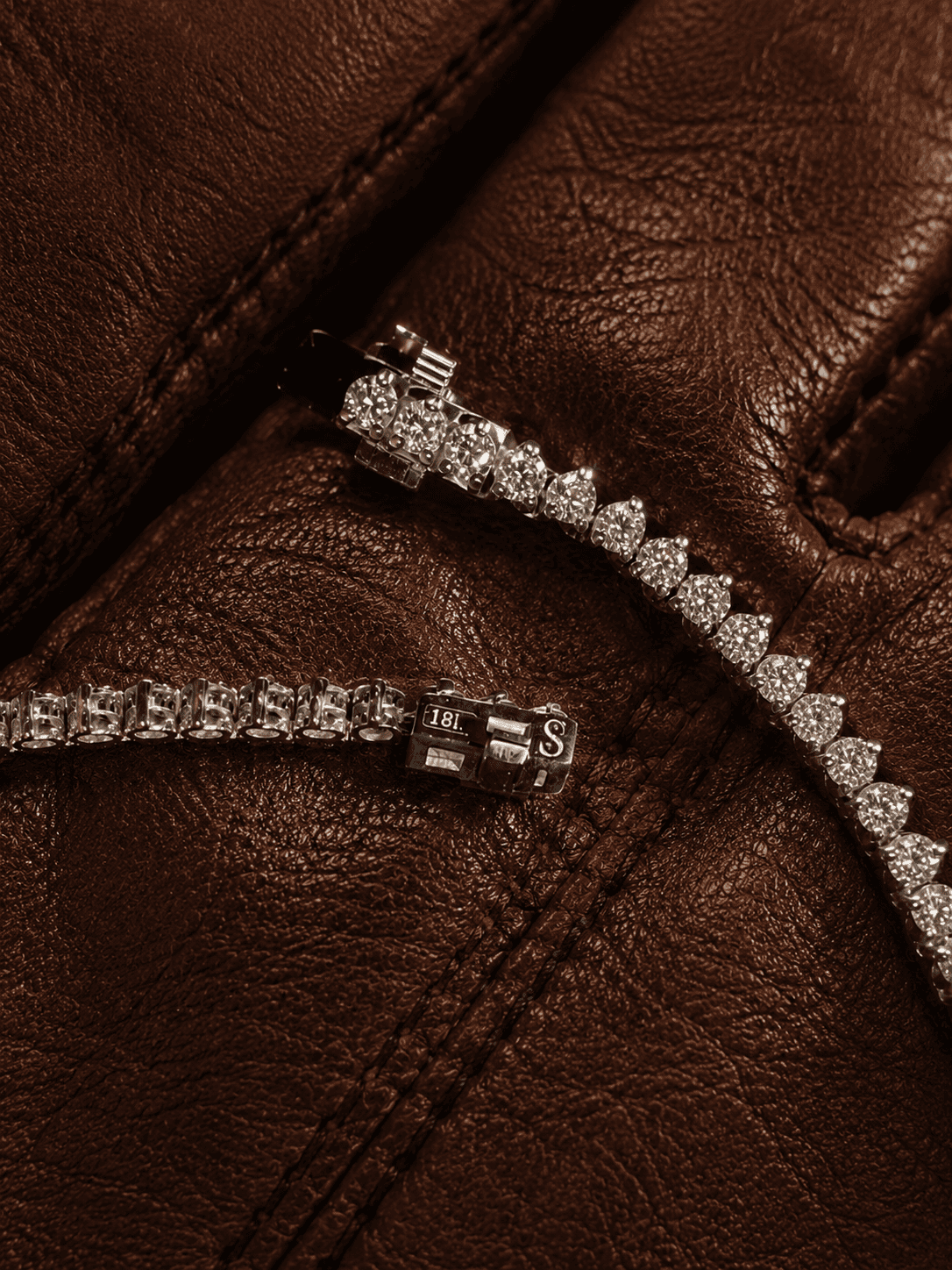
You invest in a stunning tennis bracelet. You clasp it around your wrist, admiring the brilliant row of diamonds. But five minutes later, you look down and see nothing but a plain line of metal. The beautiful gemstones have flipped completely upside down, hiding against your skin.
If you find yourself constantly readjusting your tennis jewelry throughout the day, it is not your fault, and it is not a flaw in how you wear it. It is a flaw in the engineering.
To understand why mass-produced tennis pieces flip and why bespoke, handcrafted pieces do not we have to look at a simple rule of physics: the center of gravity.
The Factory Flaw: Top-Heavy and Unbalanced
In the commercial jewelry industry, mass production is driven by cost efficiency. Because gold and platinum are expensive materials, factories often design their tennis bracelets and necklaces to use as little metal as possible. They create thin, lightweight metal "baskets" (the settings that hold each stone). However, natural gemstones whether they are diamonds, sapphires, or spinels carry significant weight.
When you place a heavy gemstone into a very light, hollowed-out metal base, the jewelry becomes incredibly top-heavy. Just like a ship without a heavy keel, a top-heavy bracelet is unstable. The moment you move your wrist, gravity takes over, pulling the heaviest part of the bracelet (the stones) downward, causing the entire piece to flip over.
The Bespoke Secret: Engineering the Center of Gravity
Master jewelers approach a tennis bracelet not just as artists, but as structural engineers. They understand that to keep a stone facing upward, the bottom of the bracelet must act as an anchor. When a bespoke artisan crafts a custom tennis piece, they do something factories will not do: they carefully calculate the center of gravity for every single link.
Here is how the engineering works:
1. The Gold-to-Gem Ratio: The jeweler measures the exact carat weight and depth of your chosen stones.
2. Weighting the Base: Instead of hollowing out the gold underneath, the artisan adds deliberate, calculated weight to the bottom of the metal basket.
3. Lowering the Anchor: By ensuring that the metal base is slightly heavier than the gemstone it holds, the center of gravity is shifted to the very bottom of the piece.
Because the base is the heaviest point, gravity pulls the bottom of the bracelet down toward your skin. This naturally forces the top of the bracelet where the diamonds or sapphires are set to face directly up, constantly catching the light.
Invest in Flawless Engineering
A piece of fine jewelry should be a joy to wear, not a chore to manage. When a tennis bracelet or necklace is engineered with its center of gravity in mind, it becomes a maintenance-free masterpiece that stays exactly where it is supposed to be.
If you are tired of adjusting your jewelry and are ready to experience the difference of true, calculated craftsmanship, Siamrington specializes in structurally flawless bespoke tennis jewelry. Whether you desire classic diamonds, deep unheated sapphires, or vibrant natural spinels, the master artisans at Siamrington calculate the exact metal weight required for your specific stones. The result is a perfectly balanced, custom-engineered piece that always keeps your gems facing the light.