For those who are deciding to buy a real diamond, just checking which diamonds are real and which are fake diamonds is enough detail. But it was discovered that real diamonds are divided into different types. Today, Siam Rington will explain in a simple way how many types of real diamonds there are to help you decide and compare products with your needs later.
Real diamonds are simply divided into 4 types:
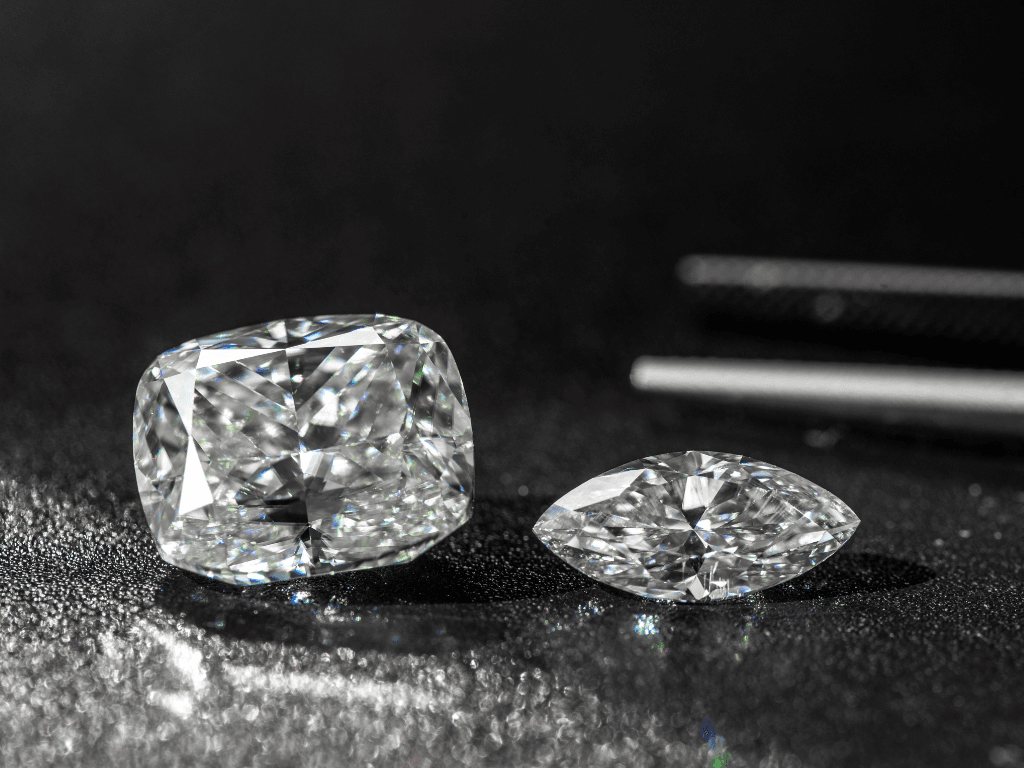
Real diamonds from natural mines

are diamonds that are formed from high pressure and heat accumulated over a period of millions of years.
This causes these carbon elements to transform into new diamonds with different characteristics depending on the environment. As time passes, these diamonds are pushed up to the earth's surface by various causes, such as volcanic eruptions or new movements of the earth's crust.
People bring them up to polish them into new shapes or angles as desired until they become diamonds as we see in the market in the end.
Read more details about natural real diamonds here
Lab grown diamonds

are diamonds that are created from a process that simulates nature to become crystals without having to spend millions of years accumulating pressure or temperature.
These types of diamonds are gassed or simulated by pressure to allow carbon to form into square-shaped crystals, or graphite is transformed to look like diamonds, whether in terms of hardness, specific gravity, thermal conductivity, or electrical conductivity.
Therefore, lab-grown diamonds are currently considered real diamonds, not artificial diamonds.
Read more about lab-grown diamonds
https://siamrington.com/article/what-is-lab-grown-diamond-is-it-a-real-diamond
Fancy colored diamonds

These are diamonds that have their color from the diamond-making process, ranging from blue, red, to black. Most of them are Z-grade diamonds or have a color value higher than Z-grade.
Reasons for fancy colored diamonds
- Mixing of other elements in the diamond crystal, such as blue, gray from the mixing of boron. The more boron a diamond has, the darker the color of the diamond will be, and the higher the price. Yellow, orange from the mixing of nitrogen.
- Radioactive contamination in the diamond-making process The above causes the arrangement of carbon in the diamond crystal to change its position and appearance, resulting in color, such as green.
- Very high pressure and temperature cause the arrangement of carbon to change, such as pink, red.
- Abnormally high hydrogen content, such as purple.
- A higher than normal amount of graphite, such as black.
Read more about fancy diamonds
https://siamrington.com/article/what-color-fancy-diamonds-are-the-most-expensive
Diamonds from the quality improvement process

Treated diamonds
are diamonds that are made from a process of being reworked from the original substandard diamonds, whether in color, cut, flaws, or other characteristics. This process will help improve and repair the diamond and gems to be completely new according to market demand.
Examples of quality improvement processes
- Crack filling
This is a process that is often used in cases where diamonds have cracks by adding chemicals with a refractive index close to that of the diamond. The filling is done in a vacuum to remove the air from the crack, and then molten glass is inserted into the crack.
- Using a laser to remove black inclusions, and then bleaching them again.
- Irradiation to obtain the desired colors.
- Color coating to make the diamond whiter. However, diamonds that have gone through the color coating process can peel off, which may cause scratches later.
If you don't know where to choose Finding a shop or factory that can talk and ask for details at every step will make you confident that the diamond jewelry you get is worth the money you pay and truly understands your needs.

Let Siamrington help be the manufacturer and manufacturer for every piece of your work. You can talk, consult and ask for details comfortably with a complete service at every step.
With the reliability of the craftsman team for more than ten years, trustworthy, honest, meticulous
For more information, please contact