The Power of the Perfect Circle: The Round Cut Advantage
For decades, the Round Brilliant Cut has been the undisputed standard for tennis bracelets and necklaces. But this is not just a matter of tradition; it is a matter of strict mathematics and geometry.
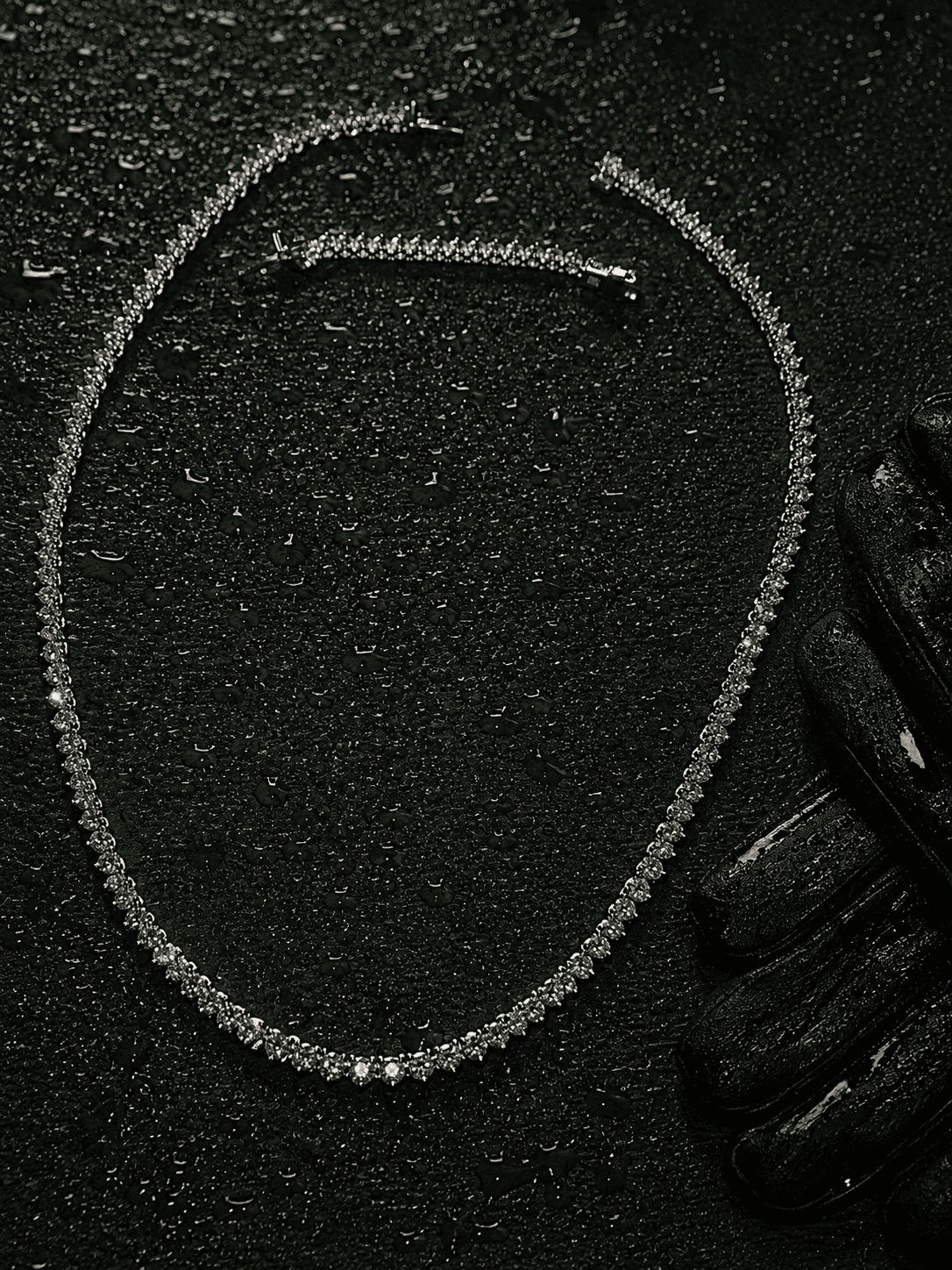
Maximum Fire and Sparkle: The Round Brilliant Cut is geometrically designed with 57 or 58 tiny mirrors (facets) angled perfectly to bounce light back up to your eye. When you line up 50 of these round diamonds next to each other, they create a continuous, blinding wall of light that no other shape can truly match.
The Seamless Fit: Think of a row of perfectly round coins. When placed side by side in a straight line, they look even and uniform. In jewelry making, round diamonds sit beautifully next to each other, allowing the jeweler to place the tiny metal claws (prongs) easily at the four corners. This creates a clean, unbroken ribbon of light with virtually no awkward spacing.
The Oval Illusion: The Challenge of Fancy Shapes
"Fancy Cuts" refer to any diamond shape that is not perfectly round such as Oval, Emerald, Marquise, or Pear. While an Oval Cut is very popular right now for engagement rings because it looks larger, using it in a tennis piece is highly complicated.
The Gap Problem: Unlike perfect circles, ovals are elongated. When you try to line up 50 oval diamonds end-to-end, their curved tips do not fit neatly together. This creates small, unavoidable "dead spaces" or gaps between every single stone.
The Metal Distraction: To fix these gaps, the jeweler is forced to use more gold or platinum to secure the stones. They have to carefully calculate the exact distance between the prongs and add tiny metal bridges. If this is not done with master-level precision, you end up seeing too much metal and not enough diamond. The bracelet will look heavy and clunky rather than elegant and light.
The "Bow-Tie" Effect: Many oval diamonds suffer from a dark shadow across their center, known as the bow-tie effect. If a factory simply lines up a parcel of mixed ovals, these dark spots will jump out, breaking the beautiful line of sparkle.
How to Make Fancy Shapes Work
Does this mean you should never use an Oval or Emerald cut for a tennis piece? Not at all. It just means you cannot rely on mass-produced factory jewelry.
If you want a Fancy Cut tennis bracelet, you need a true bespoke jeweler who understands structural engineering.
A master jeweler will hand-pick every single oval diamond to ensure their proportions are identical. They will mathematically calculate the exact millimeter distance needed for the metal settings, creating a custom mold that minimizes the gaps and hides the metal, making the stones appear as if they are floating.
Conclusion: Geometry is Everything
Not all diamond shapes are created equal when it comes to continuous jewelry. While the classic Round Cut offers maximum brilliance and a naturally seamless fit, Fancy shapes like the Oval require complex engineering and expert stone matching to look their best. Understanding these geometric rules will help you choose a design that stays brilliant, unbroken, and beautiful from every angle.
Ready to design a structurally flawless piece?
Whether you want the blinding fire of a classic Round Cut or the unique elegance of a perfectly engineered Oval Cut tennis bracelet, standard retail stores often lack the technical precision required to do it right. You need a dedicated expert.
Based in Thonburi, Siamrington is an independent bespoke fine jewelry studio led by Beam and her expert team. They specialize in the complex mathematics of continuous jewelry design.
By personally hand-selecting every gemstone and meticulously calculating the precise distance between every single prong, Siamrington ensures that your custom tennis bracelet or necklace will flow seamlessly with maximum brilliance and zero awkward gaps. Consult with Siamrington today to bring your flawless vision to life.